

Building in public on LinkedIn is uncomfortable. Here’s how to start.
A practical reframe for founders who know LinkedIn matters but keep putting it off.

👋 Hi, it’s Olivia, and I’m here with this week’s edition of The Midnight Text—Forum Ventures’ newsletter tackling the honest, messy, and often unspoken moments that keep founders up at night. I’m a Partner & COO at Forum Ventures. I’ve spent my career building brands, launching products, and turning early traction into real momentum. I’m a generalist at heart, most at home in the zero-to-one chaos.
Before I jump in, a quick, exciting note. This week we opened up applications for our second cohort of Builders Between Ventures, a validation sprint for people with an insight or idea they can’t shake, but aren’t ready to start a company yet. It’s six focused weeks to figure out whether that insight could actually become a real business. And if we decide to move forward together, it includes $250K plus full team support to build momentum. Apply here.
Up today: How to start building in public, even if it makes your stomach drop a little.
This is one of the most common questions I get from founders. So common, in fact, that I ended up writing an entire LinkedIn playbook about it. But before tactics, frameworks, and posting schedules, there’s something more fundamental that usually gets in the way.
When I say “building in public,” I mean building awareness and affinity with the people you actually want to influence, like customers, investors, future hires.
That’s why I usually suggest founders start with LinkedIn. It’s not perfect, but it’s the easiest on-ramp. Your customers, investors, and future hires are already there, and you don’t need to build a new audience from scratch to start showing up.
When founders tell me they’re hesitant to build in public, it’s rarely because they don’t understand the upside. Most people get it, intellectually. What stops them is more personal.
They worry they’ll sound dumb. Or repetitive. Or like they’re trying too hard. They worry people from their past will see them and judge them: Former coworkers, old bosses, friends from another chapter of life. And a big one I hear a lot: what if I post something thoughtful and it completely flops?
That fear is incredibly common. It’s not a founder thing or a confidence issue. It’s a human one. Putting your thinking out in the open means accepting that other people might judge it, misunderstand it, or disagree. That’s uncomfortable for almost everyone.
I felt it too.
When I started posting consistently, I didn’t feel confident. I felt exposed. I work in VC, which added another layer of self-consciousness. Would people think I was posturing? Would founders roll their eyes? Would peers assume I was trying to sound smarter than I felt?
That discomfort is the cost of entry. And almost everyone you admire on LinkedIn felt it at the beginning too. You’re just seeing the output now, not the nerves.
Once you embrace that reality, you must get clear on what you’re trying to accomplish by posting on LinkedIn. For me the unlock was getting honest about:
Who I was trying to reach and what they cared about
What real, lived experience I had
What patterns I was seeing again and again in my work
That’s essentially what content pillars are. The intersection of your experience and goals and what your audience cares about. When you’re clear on your audience and your lanes, you stop asking, “What should I post?” and start asking, “What did I notice this week that would actually be useful to them?”
A quick practical note, since people always ask: you don’t need to post every day. Consistency matters far more than frequency. For most founders, two to three posts a week is plenty. The goal is to build the habit of showing up, not turn this into another thing you beat yourself up over.
The impact can be incredible and I see this very clearly across our portfolio.
Founders like Kait Stephens at Brij, Trenton Hughes at ArgoIQ, and Jared Kleinert at Offsite are all driving real outcomes from LinkedIn. They’re generating inbound conversations, qualified pipeline, and revenue they can trace back to showing up and posting consistently.
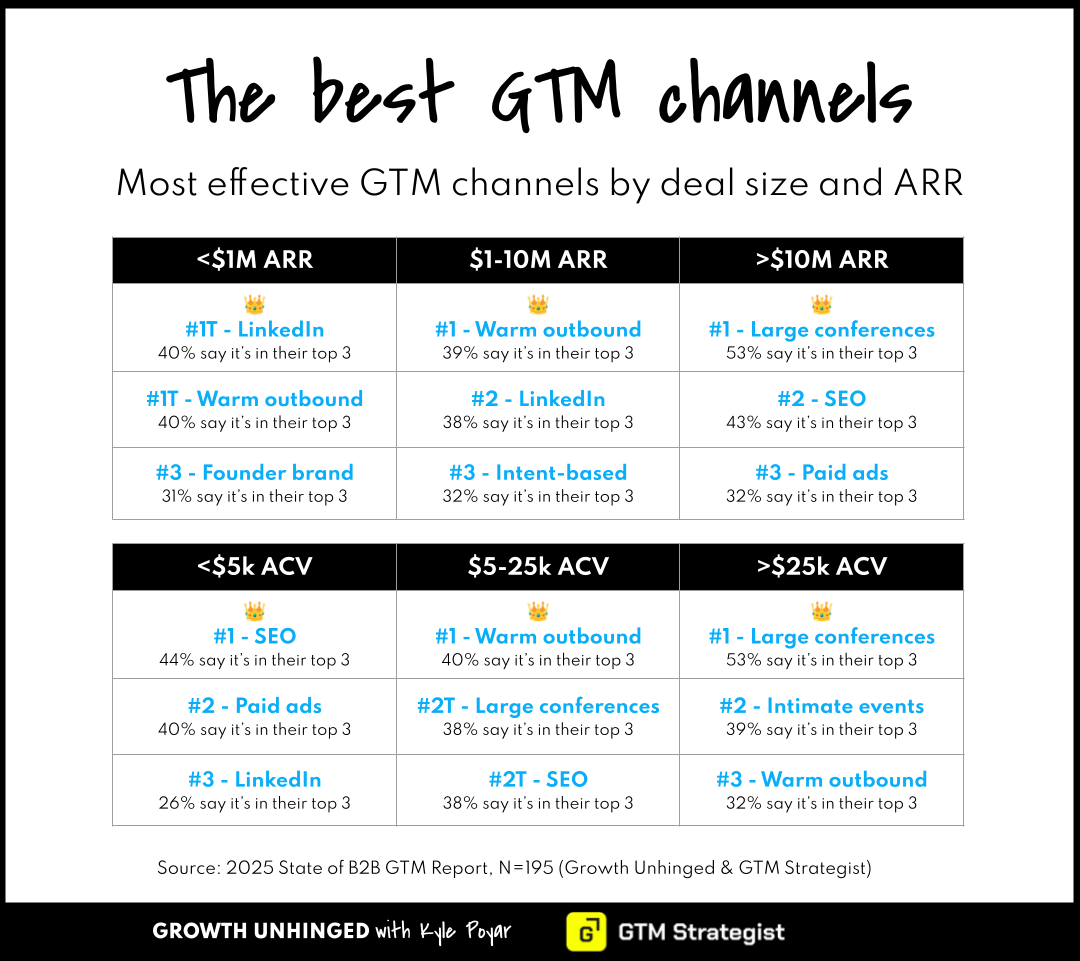
Kyle Poyar’s GTM survey data echoes what I’m seeing across our portfolio. It consistently shows LinkedIn as one of the most efficient channels for early-stage teams, especially when resources are tight and every channel has to earn its keep.
The payoff also rarely shows up immediately. It shows up over time.
A customer references a post on a call. An investor mentions they’ve been following along. Someone reaches out and says, “This articulated something I’ve been struggling with but couldn’t quite name.”
That’s when you realize you’re not shouting into the void. You’re quietly building context, trust, and familiarity, long before you need it.
One last thing that’s worth saying clearly: building in public doesn’t mean sharing everything. You don’t owe the internet your worst days or your rawest moments. You can be honest without being exposed. Transparent without self-sabotaging.
Often, the most valuable posts aren’t about failure at all. They’re about insight—the belief you changed your mind about, or the lesson that only became clear after watching the same problem play out again and again.
If you want to go deeper on the tactical side, including how often to post, how to find time, hacks and optimizations, and how this can actually feed a real pipeline over time, I’ve written a full LinkedIn playbook here:

For now, start small. Post it. Let it be imperfect. Let it flop (because it will). Then do it again.
The founders who move through the discomfort don’t just build audiences. They build affinity. They build pipeline. They build momentum. And over time, they build real credibility.
And that’s incredibly powerful.
Until next time,
Olivia
If you found this helpful, share The Midnight Text with another founder!
If you’re an early-stage B2B SaaS founder building something awesome and looking for your first check and unmatchable support, learn more about our accelerator here, and pitch us here.
If you’re an early-stage B2B SaaS founder with an awesome idea and deep domain expertise, and are looking to build with an experienced team, learn more about our venture studio here, and find out what we’re most excited about here.
Everyone starts somewhere. The best part is, people will respect the hustle and help out much more than you realize! Don’t try to be an expert, just share what you are experiencing and you’ll be shocked what happens!